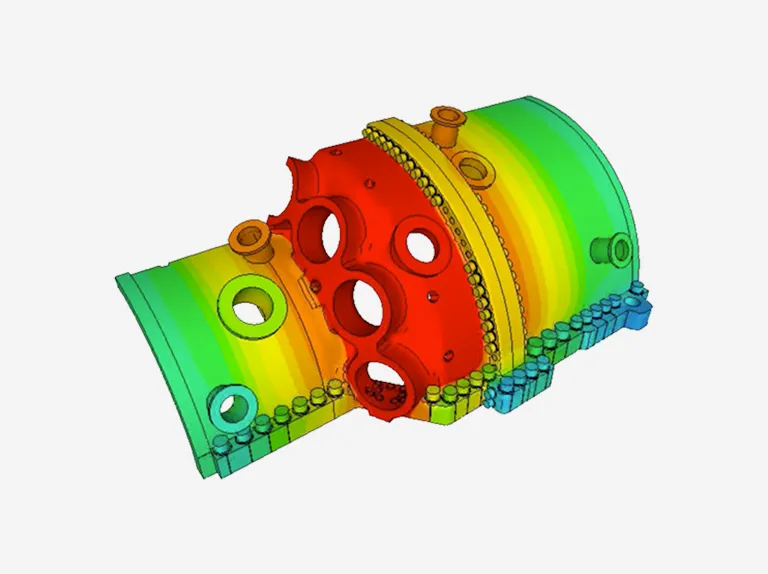
FEM calculation: Accuracy of detail meets reliability

We open up the world of precise FEM calculation to you. Our finite element method (FEM) offers the solution to your most complex challenges. The answer to high prototype costs and pressure to innovate: FEM calculations from ITB. Use our experience to bring your products to market faster, safer and more cost-effectively.

Why FEM calculations?

Every new product carries risks, both financially and in terms of time to market. These risks are only compounded by high prototyping costs and the pressure to innovate. Every wrong decision can be expensive.

The Finite Element Method (FEM) changes the approach to such technical problems. We enable you to delve deep into the matter and create realistic simulations. Your results will be more accurate and your product developments will progress faster.

Detailed analysis of complex geometries

FEM makes it possible to model and analyze very complex structures and systems that are difficult to calculate using traditional analytical methods.

Versatility

It can be used for a variety of physics and engineering problems, including structural mechanics, heat transfer, fluid mechanics, electromagnetism and more.

Precision and adaptability

FEM calculations can be very accurate, especially if the mesh is fine enough. Users can refine the mesh in areas of higher stress or heat generation to achieve more accurate results.

Reduction of development time and costs

By using FEM, physical prototypes and experimental tests can be reduced, resulting in significant time and cost savings.

Risk reduction

It helps to identify and resolve potential problems in the design phase before they lead to costly failures in production or operation.

Optimization of design and performance

FEM enables the investigation of different design variants and the optimization of products for better performance and higher efficiency.

Support for compliance with standards and regulations

Through accurate simulations, engineers can ensure that their designs comply with applicable industry standards and safety regulations.

Better understanding of products and processes

FEM provides detailed insights into the behavior of products under real-world conditions, leading to a deeper understanding and improved solutions.

Integration into the product development cycle

FEM can be used at various stages of product development, from the concept phase to final inspection.

Real success with finite element calculation – The applications

Anlagenbau
Appliance and plant engineering
Baumaschinen
Construction machinery/cranes
Konsumgueter
Consumer goods
Defence
Defence
Elektromobilitaet
Electric mobility
Vorrichtungsbau
Fixture engineering
Gasturbinen
Gas Turbines
Waermebehandlung
Heat treatment
Lastaufnahmemittel
Load handling equipment
Druckbehaelter
Pressure vessels

Further industries: Automation, Automotive, Nuclear Technology, Agricultural Machinery, Logistics, Aviation, Mechanical Engineering, Nuclear Containers, Rail Vehicle Manufacturing and Shipbuilding.

Finite element simulation in action

ITB offers you a wide range of services

Our FEM analyses offer you detail and versatility while reducing the cost and time of prototype testing. Our expertise makes the difference.

Detailliertes FEM-Netz einer kompletten Gasturbine für strukturdynamische Berechnungen und Modalanalyse
Static Calculation
Dynamische FEM-Analyse einer Rahmenstruktur mit farbiger Darstellung der Verformungen und Spannungsverteilung
Dynamic Calculation
Kurzzeitdynamische FEM-Simulation einer Rohrverbindung unter Impaktbelastung mit zeitabhängiger Verformungsdarstellung
Short-term Dynamic Calculation
Thermische FEM-Spannungsanalyse eines Rohrflansches mit farbiger Temperaturverteilung von blau bis rot
Thermal Calculation
FEM-Netz einer Bauteilstruktur mit verfeinertem Netz an der Rissspitze für bruchmechanische Berechnung
Fracture Mechanics Calculation
3D-Response-Surface-Diagramm einer Sensitivitätsanalyse mit Parametervariation und Optimalpunkt-Markierung
Sensitivity and Robustness Analysis
FEM-Modell eines Maschinenteils mit Netzdarstellung als Basis für die strukturmechanische Bauteiloptimierung
Component Optimisation

Frequently asked questions about the finite element method (FEM)

The finite element method (FEM) is a numerical technique for solving complex physical problems.

The finite element method (FEM) is a numerical technique for solving differential equations that is used in many areas of engineering and physics. The FEM breaks down a complex problem into smaller, easy-to-handle parts called “elements”. These elements are mathematically modeled to approximate the solution of the overall problem.

Here is a basic explanation of how the finite element method works:

  1. Discretization of the domain: First, the physical problem or domain is divided into smaller, non-overlapping elements. These elements can have different shapes, such as triangles or quadrilaterals in 2D or tetrahedrons or hexahedrons in 3D. The boundaries of these elements are called “nodes”.

  2. Setting up the equations: Equations based on the laws of physics (e.g. Navier-Stokes equations in fluid mechanics or the heat conduction equation in heat transfer) are set up for each element. These equations describe the behavior of the element in relation to the desired quantity, such as displacements, temperature or pressure.

  3. Assembling the global systems of equations: The equations for all elements are assembled into a global system of equations that covers the entire domain. This is done by considering the boundary conditions and the interactions between the elements.

  4. Solving the system of equations: The resulting system of equations is usually a system of algebraic equations. This system is solved to calculate the unknown quantities (e.g. displacements or temperature distributions). There are various numerical solution methods, including iterative methods such as the conjugate gradient or direct solution algorithms such as Gaussian elimination.

  5. Post-processing: After the system of equations has been solved, the expected results can be extracted in relation to the quantities sought. This can include the calculation of stresses, deformations, temperature distributions or other physical quantities.

The finite element method is extremely versatile and can be used in a wide range of applications, including structural mechanics, heat transfer, fluid mechanics, electromagnetics and many others. It allows complex geometric shapes and boundary conditions to be taken into account and is therefore a powerful tool for analyzing and solving physical problems in engineering and scientific disciplines.

ANSYS is a leading software for FEM analyses that allows us to carry out complex simulation processes efficiently and precisely.

Thanks to our many years of experience in FEM analysis simulation for static & dynamic calculation, as well as a deep understanding of the project business, we offer prices in line with the market and understand individual customer needs.

Through continuous cooperation, we guarantee only reliability and a fixed contact person in our company. We attach great importance to fast, fair and open communication at eye level.

Use ITB's expertise for your finite element analysis

Join the leading companies that already benefit from the expertise of ITB Ingenieurgesellschaft. Through our specialized FEM calculation and ANSYS application, we can turn your challenges into tangible solutions. Don’t wait any longer. Let’s achieve top performance together.

Pascual Paquee – FEM-Experte bei der ITB GmbH

Talk to Our FEM Expert

Pascal Paqueè, M. Eng.
Team Lead FEM

News

April 2025
ITB Pune is 1 year old!

April 2024
Lecture by Yannick Lattner (CFD engineer) at the ISimT-24: Symposium on Innovative Simulations in Turbomachinery

April 2024
Foundation of ITB Pune, Rushab Oswal as new Managing Director.

April 2024
Our company has been a member of the sponsoring association of the KIMW (Kunststoff Institut) since April 2024

April 2024
Reinhard Houben, Member of the German Bundestag, visits ITB in Dortmund

Oktober 2023
In October 2023, we received approval from the Federal Ministry for Economic Affairs and Climate Protection (BMWK) for the ZIM individual project “Development of a scalable service for the simulation of light guides with variant calculation and automated workflow”.