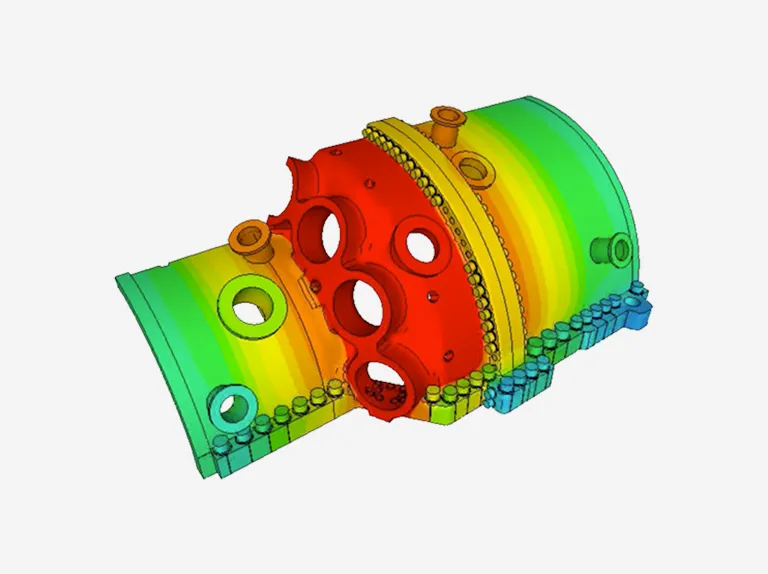
The static calculation is used for structural mechanics tasks dealing with static or quasi-static loads. For economic reasons, an attempt is also made to describe non-static loads in terms of quasi-static equivalent loads. Such tasks can be solved by a static calculation using FEM simulation, but also in some simple cases analytically.
For more than 250 satisfied customers we performed static calculations in the following fields of activity:
- Calculation of the load capacity
- Calculation of the fatigue strength
- Limit load analysis
- Component optimization
The load data are often the result of other calculation disciplines and can be imported from corresponding calculations, e.g. component temperatures from stationary or transient thermal calculations, and surface pressures from flow simulations.
The static calculation can be used to optimize the components, or by combining it with a strength verification, to ensure the admissibility of your components. In all cases, you will gain a deeper understanding of force flow and deformation in your components.
Furthermore, cyclical load conditions can be described by quasi-static load conditions. In this way, the stresses can be determined by means of static calculations for the proof of fatigue strength as well as for proof of load-bearing capacity.
In the simplest case, the lower and upper load on the components is known. But even if the lower and upper load cannot be precisely defined, we have methods to efficiently map the operation of the component through a static calculation and thus determine the relevant load situations.
We have many years of experience in performing static FEM simulations for various industries. Our scope of services includes the performance of linear and non-linear static calculation, from individual components all the way up to large assemblies. Non-linear FEM simulation models take into consideration e.g.
- Non-linear, e.g. plastic, material behaviour
- Static equilibrium for larger deformations (theory of 2nd or 3rd order, buckling, bulging)
- Definition of contacts, e.g. for describing sliding and lifting
We use the non-linear static calculation to determine the limit load of components for our customers. This means that real tests can be reduced or replaced using FEM calculations, thus saving time and money.
Using a non-linear static calculation considering the theory of III. Order, plastic material behavior and imperfections, the stability of structures can be assessed, or the buckling behavior can be examined. This method represents an alternative to the stability analysis on the basis of buckling or buckling eigenvalues. With a preceding eigenvalue determination, decisive component imperfections can be identified.