Light Simulation – Realistic Analysis of Optical Systems

Light simulation has established itself as an essential tool in the fields of design and engineering. It enables the precise analysis, optimization, and visualization of complex lighting effects — from the light source through light guides to the receiver. Physics-based simulations reduce development cycles, minimize the need for physical prototypes, and sustainably improve the quality of lighting systems.
Why Light Simulation for the Analysis of Optical Systems?
Light simulation provides detailed insight into luminous conditions and enables the efficient optimization of design parameters. Compared to conventional experimental setups, it saves time, materials, and costs while opening up new opportunities for innovation, sustainability, and iterative prototyping.
Greater Efficacy, Higher Efficiency, and a Better User Experience for Your Customers
Superior luminous efficacy, higher energy efficiency, and a compelling user experience are critical to the success of modern optical systems. This is precisely where we come in: we handle the complex development work on your behalf and ensure your products deliver maximum added value to your customers.
Using state-of-the-art light simulation, we optimize your systems with precision and real-world applicability, reducing development effort and shortening time-to-market. This allows you to enhance product quality while benefiting from our expertise and focusing on your core business.
Physical Accuracy
Our simulations realistically reproduce luminous flux distributions, reflections, refractions, and scattering across the full spectral range — including wavelengths beyond the visible spectrum.
Virtual Testing Instead of Prototypes
Reduce development time and costs: virtual testing allows various designs and materials to be digitally evaluated and optimized before any physical prototype is built. This conserves resources and accelerates the entire development process.
Efficiency and Sustainability
Simulation-based analyses enable targeted reductions in energy consumption, material usage, and manufacturing effort. This not only contributes to sustainability goals but also lowers operating costs — a benefit you can pass directly on to your customers.
Design Optimization
We optimize luminous uniformity, illuminance, color mixing, and glare characteristics so that your lighting solutions are both technically sound and visually compelling.
Safety and Comfort
Optimized lighting systems improve visual perception, reduce glare, and increase safety in technical applications — from automotive lighting to controls and displays.
Communication and Visualization
Photorealistic 3D renderings make simulation results clear and persuasive — both for internal development decisions and for presentations to your clients. Concepts can be aligned at an early stage and implemented with focus.
Software Tools
For light simulation, we use industry-leading software offering the highest levels of accuracy and flexibility:
- Ansys Speos: Ideal for the realistic simulation of complex optical systems, including multiphysics coupling and GPU-accelerated real-time computation.
- LightTools (Keysight): Specialized in illumination design and light guide optimization — featuring advanced ray tracing algorithms and automated optimization routines.
Light simulation is more than an analysis tool — it is a key technology in modern product development. By combining cutting-edge software, rigorous physical models, and years of experience, we enable our clients to design their optical systems efficiently, sustainably, and to the highest quality standards.
Delve deeper into light simulation


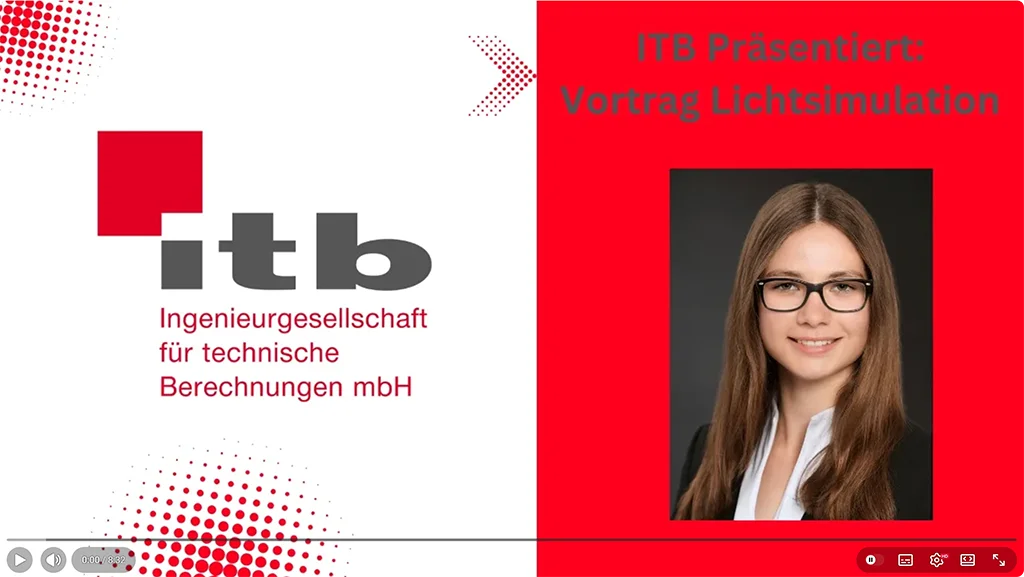
As part of the BVMW e.V. virtual coffee break, our lighting expert Svenja Potthast gives a compact overview of the possibilities of modern light simulation.
Watch the short talk on YouTube now and learn more about light simulation at ITB.
Want to learn more about Light Simulation?
Whether you are facing a specific challenge or are interested in learning more about the possible applications of light simulation in your company – we will get in touch with you quickly and easily.
Write to us via our contact form or book an appointment directly with our light simulation expert.

Talk to our light simulation expert
Svenja Potthast, M. Eng.
Team Lead Light Simulation
- svenja.potthast@itb-fem.de
- +49 (0)231 94 53 65 - 27
- Book an appointment with our light simulation expert
“For me, sustainability begins in development. With precise light simulations, we create the basis for energy-efficient, standard-compliant products – even in the digital design. My goal is to design this technology in such a way that small and medium-sized companies also benefit from it: affordable, practical, forward-looking.”