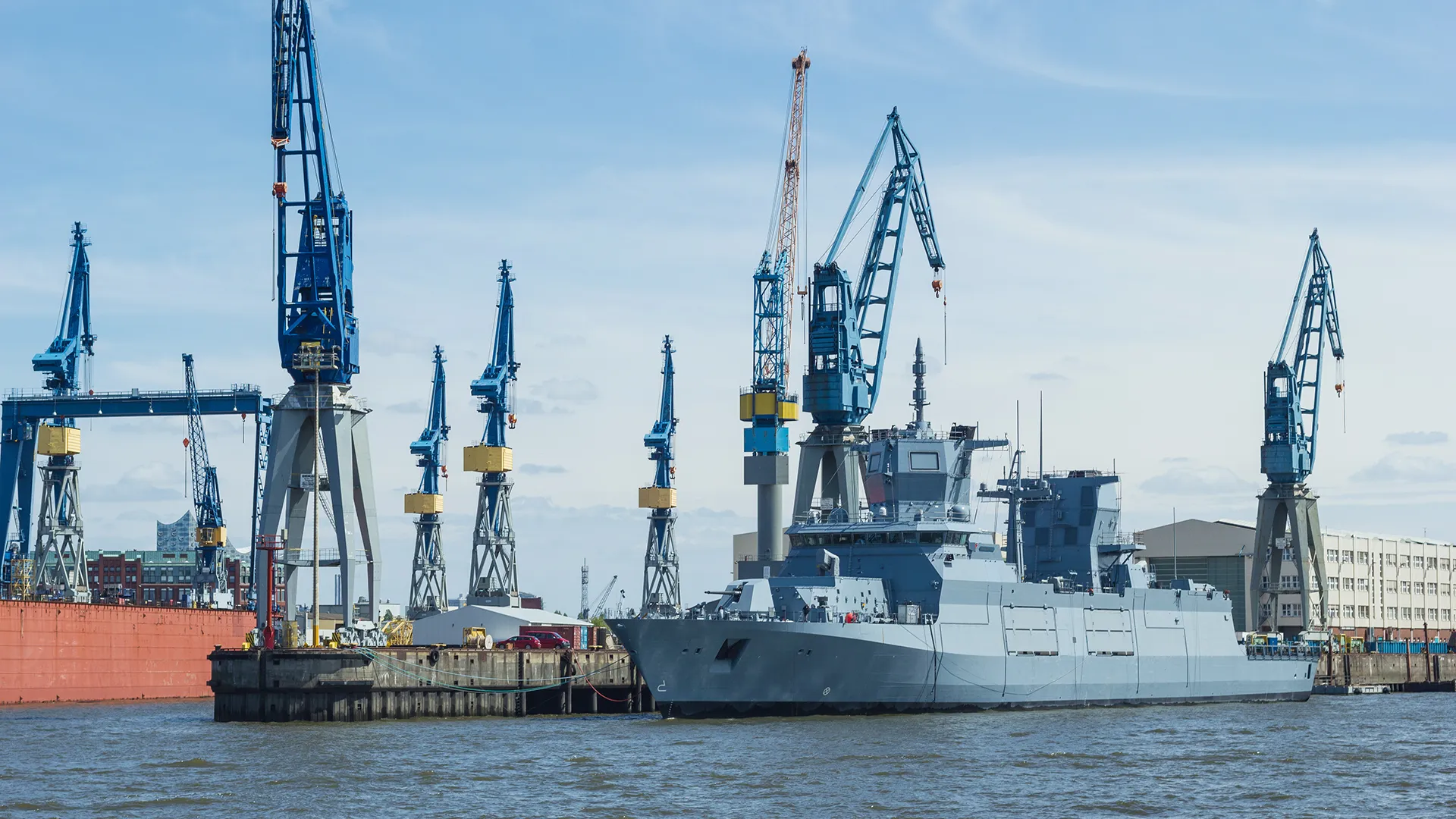
In the field of defence technology, we have experience in performing FEM calculations of Surface Warships. The operational purposes of Surface Warships are manifold. They are used for Defense Alliance, crisis prevention or humanitarian missions. Defence technology deployed on the high seas has to therefore meet correspondingly high and versatile requirements.
Ship classes such as the Frigate can be exposed to high shock loads in an emergency. However, maneuverability of the vessel in such scenarios must always be maintained. Therefore, components such as rotary vane rudder motors or fin stabilizers must be designed accordingly with regard to their static strength and serviceability.
The decisive loads usually result from the action of shock loads in various spatial directions, as well as the operating loads, such as oil pressure in hydraulically operated components, and additional hydrodynamic loads due to water displacement at the Rudder.
Usually,the components are evaluated by performing the covering quasi-static calculations. If necessary, transient shock analyses with time-dependent shock characteristics are performed.
The result evaluation is performed according to the specifications of the German Federal Armed Forces on the basis of the BVO43, as well as the BVO230 of the Federal Office of Defence Technology and Procurement. In addition, verifications according to VDI 2230 and the FKM guideline are also performed.
The basic material as well as bolted joints and Seals are evaluated with regard to various aspects:
- Evaluation of the static strength
- Determination of the Eigenmodes and -frequencies
- Evaluation of deformation (impermeability; free movement of Seals)
- Force curves due to transient shock loads applied to bolted connections
- Rudder bearing forces due to transient shock loads
Your advantage through simulation
With the help of an FEM calculation, deformations and stresses are determined locally. This makes it easy to localize critical areas and optimize them during the development phase. Favorable as well as unfavorable effects, which may have been previously unknown or undetected, are revealed and thus improve new and further developments in the future. This saves valuable development time and thus development costs. But of course, existing components can also be examined and re-evaluated for new, increased load scenarios and other purposes.
Documentation of calculation results
Depending on the customer’s requirements, the calculation results are documented as a verifiable calculation report (e.g. by DNV GL) in German and English or in the form of a PowerPoint presentation. In consultation with you, we present the results that are important for you in a clear and understandable way.
Guidelines
- BVO43 – Construction Regulation for Ships of the German Armed Forces 043 Shock Safety
- BVO230 – Shock safety
- VDI 2230
- FKM guideline