The air exchange rate plays a crucial role in the design of ventilated flat roofs. Sufficient airflow in the roof gap must be ensured to allow the timber of the load-bearing roof structure to dry adequately. When dimensioning the roof geometry, the interaction of roof length, roof pitch, and gap height must therefore be taken into account, among other factors. It is equally important to consider the influence of the roof structure and roof attachments such as the gutter, the mansard break, and perforated metal sheets.
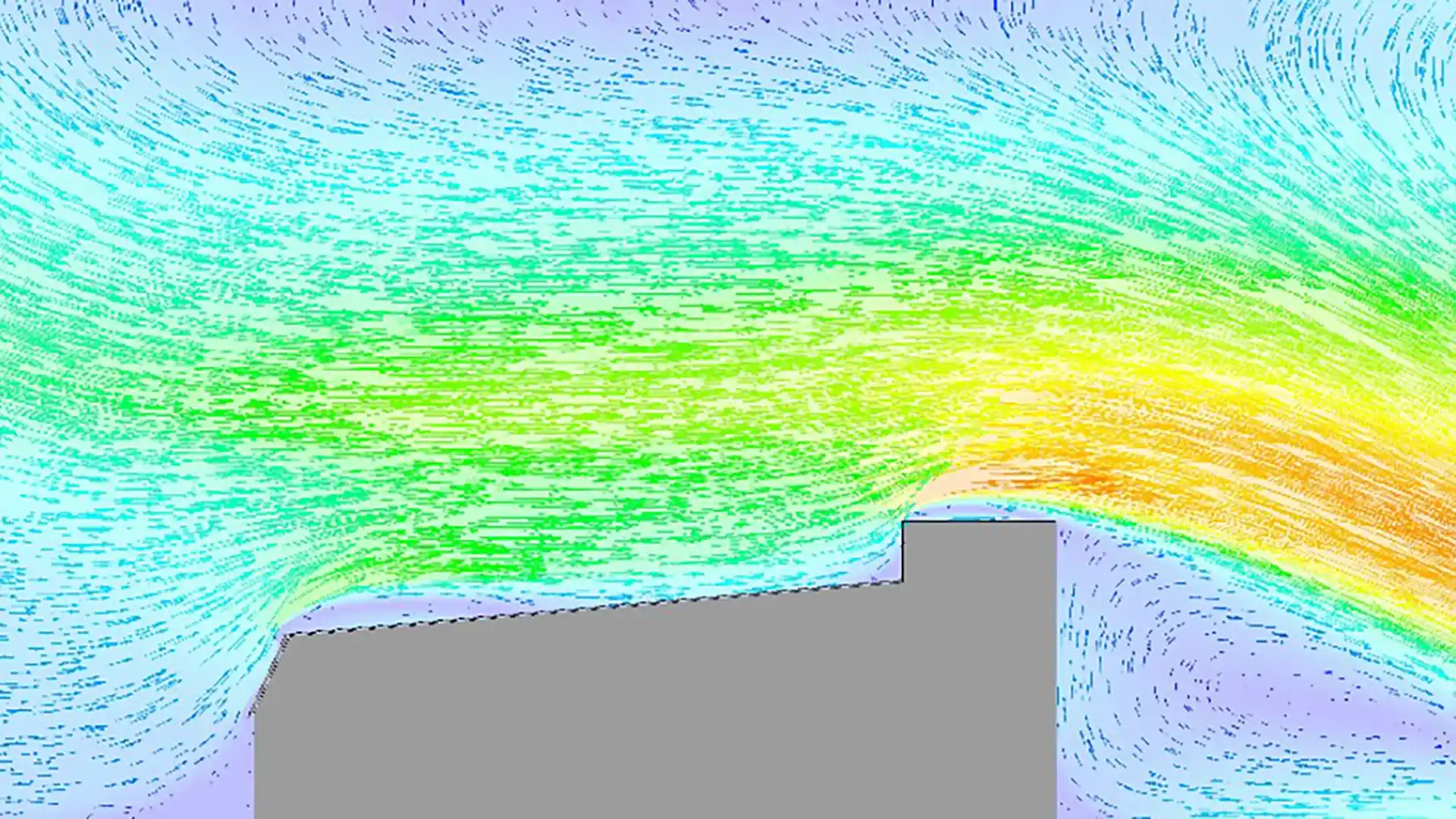
To identify the influence of these various factors, a generic 2D CFD calculation model was developed for RHEINZINK GmbH & Co. KG. This two-dimensional model allows a large number of variants to be calculated in a very short time while simultaneously taking all of the aforementioned influencing factors into account.
The calculation model enables both the computation of air velocity in the roof gap at a given external wind speed and under calm wind conditions, where air movement is driven solely by the heating of the air within the roof gap.
The simulation results provide RHEINZINK GmbH & Co. KG with a more in-depth understanding of the flow conditions in the roof gap and allow customers to select the appropriate gap height according to their specific requirements.